- Best Practices ●
- COVID-19 ●
- Industry Trends ●
- Partners ●
- Product ●
How to Use QR Codes on Clothing for Your Marketing Strategies

Billboards. TV spots. Social media. Print ads. Tracksuits?
Marketers are always on the lookout for new ways to reach their audience. And it’s well-known that today’s consumers crave interactions with their favorite brands. They don’t want to be marketed at; they want to build a two-way relationship with you.
Enter branded clothing and clothing labels. It’s a bold new reality where celebrities wear neon donut-themed tracksuits (more on that later) and customers can scan clothing tags to try on pieces, trace supply chains, or activate augmented reality experiences.
Let’s explore how the fashion industry has turned clothing into a branded, digital experience. Plus, see how you can use QR Codes on clothes for your own marketing campaign.
*Note: The brands and examples discussed below were found during our online research for this article.
5 benefits of using QR Codes in your branded clothing marketing strategy
First, let’s talk about those donut tracksuits. These luminous pink-and-orange creations were born from a Dunkin’ Donuts ad spot at the Super Bowl. To almost everyone’s surprise, what started as a joke outfit sold out within 19 minutes.
The lesson here? While hot pink and orange may not be everyone’s style, a lot of consumers are interested in clothing items as a route to interact with brands.

You might not have the budget to run a Super Bowl ad or produce top-to-toe outfits, but you can still make use of this phenomenon.
QR Codes are an amazingly flexible technology. You can print them on t-shirts, clothing tags, packaging, store signage, and more. They can link to almost any content, from augmented reality (AR) to social media platforms, coupons, and video content. Best of all, they’re inexpensive and quick to create.
If you haven’t yet begun to weave QR Codes into your marketing initiative, now is the time to do it. Here’s a closer look at the main benefits.
1. Maintain a consistent brand identity
According to research from Deloitte, 84% of consumers say it’s very important for brands to provide consistent, positive interactions across touchpoints. Not only that, but your branded merchandise is more likely to succeed if it’s supported by a consistent multimedia campaign.
Adding QR Codes to the mix is a small but mighty way to supercharge brand consistency and increase brand awareness. You can match your QR Code to your branding: implementing your brand colors, logo, tone, and style for a cohesive customer experience.

2. Streamline the shopping experience
Luxury retailers and clothing brands rely heavily on print ad spending to promote new collections. Brands that aren’t in the fashion game but want to promote branded merch will likely be working with in-person events and print ads as well.
QR Codes are the perfect way to take offline campaigns to the next level. By placing a QR Code in your print ad campaigns, your target audience can simply scan and shop.
Then there’s the post-purchase value. Clothing QR Codes can link customers to review pages, loyalty programs, or branded content. They could even serve as walking ads—ready to be scanned by anyone who admires the outfit.
3. Collect data and glean insights from your marketing efforts
QR Codes might be small, but the number of insights they deliver is almost infinite
Every scan helps to gather critical insights about your target audience, such as:
- Location: You can review where people have scanned your code by country or city, highlighting where your QR Codes are performing well.
- Unique scans: This shows you how many different devices scanned your QR Code, giving you an overall indication of customer engagement for the campaign.
- Timing: You can view scans by month, day, and even hour, which is valuable for analyzing campaign performance over time.
You can combine QR Code tracking with other data from third-party tools like Google Analytics for even more insight into the customer journey.
4. Minimize friction when priorities change
Marketing campaigns can change quickly, but it’s expensive to make updates or corrections in print (or on fabric). QR Codes make it easier to update content when you need to.
There are two types of QR Codes: Static and Dynamic. While the links in Static codes can’t be changed once they’re created, Dynamic QR Codes are flexible and editable.
With Dynamic codes, you can update marketing content without any need to reprint QR Codes. Just edit the back end: swap out links, update your display page, and change the content.
5. Win over conscious-minded customers with a commitment to sustainability
McKinsey research shows that young shoppers actively seek out fashion brands with strong sustainability credentials. The problem is how to get that product information out there.
QR Codes on tags, fabric labels, and product packaging are a simple way to share details about your raw materials, supply chain, or labor conditions. Better still, the codes themselves help to reduce paper waste. Instead of adding leaflets and marketing brochures to your ecommerce orders, you can print sustainable QR Codes on packaging.
Top use cases for QR Codes on clothing
Marketers love QR Codes because they’re so versatile. Here are just a few ways you could use QR Codes on clothing items and branded merchandise.
Share your brand story or mission
As we’ve seen, modern consumers value eco-friendly products and purpose-driven brands. QR Codes are an efficient way to give consumers more information, without cluttering product packaging or increasing paper usage. Use them to link to your mission statement, ESG reports, product certifications, or behind-the-scenes videos.
Drive sales with shoppable QR Codes
Once someone buys from your brand, you want to keep them as a loyal customer. Use QR Codes to make it easy for them to keep shopping. You could link to exclusive discounts, secret drops, influencer collaborations, recommended products, curated collections, or repeat subscriptions.
Enable product authentication
For luxury and limited-edition items, QR Codes can become live certificates of authentication. Customers simply scan the code to check that their purchase is legitimate. You can also use QR Codes to handle product registration and warranty activation, making it easier for customers to protect their purchases.
Create post-purchase engagement
Your relationship with customers doesn’t end with a purchase: it’s just the beginning. Use QR Codes to share care instructions, styling tips, outfit inspiration, referral links, loyalty programs, or any other content that’s aimed at promoting customer loyalty.
Support sustainability efforts
Use QR Codes to tell customers about your sustainability efforts, while cutting down on paper at the same time. As well as sharing sustainability information, you could link customers to repair tutorials, recycling programs, or your own refurbish and resale marketplace.
How to design and place QR Codes on apparel
You can place QR Codes almost anywhere, but that doesn’t necessarily mean you should. The secret to successful QR Codes on clothing is balancing design with functionality.
The design part is obvious. Whether you make QR Codes a feature of the design or cleverly conceal them, you’ll want to stay consistent with your brand style.
Functionality is also essential. If QR Codes are too small, blurry, low-contrast, or on a patch of clothing that creases easily, then they may perform less reliably.
Keep these considerations in mind to get the perfect look:
Fabric and placement considerations
Start by thinking about the material you’re working with. Reflective and textured fabrics won’t work as well, while plain, woven fabrics are ideal because they won’t interfere with the QR Code pattern.
Then there’s placement. Seams, buttons, folds, and movement can distort QR Codes, so it’s best to stick to flat areas. If your QR Code is the focus of the design, then the front or back of a t-shirt is ideal. For more discreet placements, try fabric labels, inside hems or cuffs, or inside the yoke of a shirt.
Print, patch, or label?
Next, consider how the QR Code will be printed. There are several different ways to print QR Codes on fabric, depending on the fabric mix, color, and complexity of the QR Code design.
Techniques like heat transfer printing, direct-to-garment printing, and dye sublimation are all accurate, widely used, and durable. However, you can also look at more creative ways to add QR Codes. Consider using adhesive or sew-on patches, embroidering QR Code patterns, or using laser cut-outs.
The method you choose will depend on your aesthetic, budget, and planned use for the garment. For example, one-off promotional t-shirts don’t necessarily have to be as durable as a couture piece.
Test before you scale
Testing is an essential step in using QR Codes on clothing. A broken QR Code is frustrating for consumers and could turn them off your brand.
You can check whether you have the correct link and file format from a computer. But you’ll also need to test QR Codes in their final placement.
Try scanning QR Codes from different distances, under different lighting, and with different smartphones. For clothing QR Codes, it’s also a good idea to test them while someone is wearing the garment. Remember that clothes will be worn, washed, and folded, so QR Codes have to withstand rigorous use.
Real examples: Brands using QR Codes on clothing today
That’s enough of the technical details; Let’s try some real-world examples on for size.
Here are some of the most creative ways we’ve seen fashion brands harness the power of QR Codes.
Bershka’s AR-enhanced fashion line
In 2023, Spanish clothing retailer Bershka released “the world’s first semi-digital clothing collection”. Translation: they worked with AR filter creator FFFACE.ME to embed TikTok filters and animations in their clothes.
The collection featured five designs, each incorporating a QR Code. When customers scanned the code, they could access the AR features to enhance their TikTok videos. Bershka attracted attention, built relationships with their customers, and got a ton of organic social media engagement.
Indiana Pacers encourage fan engagement with a jersey patch
Sports jerseys have carried adverts since at least the 1950s. But in 2024, the Indiana Pacers opened up a new frontier: QR Code patches.
Each Pacers jersey now has a QR Code on the left shoulder, which fans can scan to get exclusive content about the team. Using Dynamic QR Codes means the content can be edited regularly, so it never gets old. To round things out, the Pacers also use QR Codes on game tickets for fans to upload their own photos and videos of the day.
Patagonia promotes sustainability by reducing paper waste
Patagonia is living proof of just how effective QR Codes can be in combating waste. The outdoor clothing brand has sustainability deeply woven into its core values, using durable materials and offering repair and resale services. In 2022, it went even further.
Patagonia diverted an estimated 174,000 pounds of paper waste from landfills by switching to QR Codes on clothing tags. Not only are Patagonia’s actions positive for the environment, but they support the company’s brand reputation, too.
Diesel Denim protects its brand with authentication technology
The iconic clothing brand Diesel Denim uses QR Codes to help customers avoid counterfeit online sellers.
To do this, Diesel started printing QR Code clothing labels into the waistband of its denim jean products, which consumers could scan with their smartphone to confirm the denim’s authenticity.
Not only did this move help Diesel protect against illegal selling, but it also showed customers that Diesel cares about giving them an authentic, safe shopping experience.
Choose a fashion-friendly QR Code Generator with QR Code Generator PRO
QR Codes are invaluable tools. They provide convenience and sustainability for your customers, along with opportunities for branding and data collection.
QR Codes for clothing present new opportunities for marketing. Whether you want to educate your target audience, collect more user-generated content, or innovate with augmented-reality clothing, QR Codes are a great way to connect.
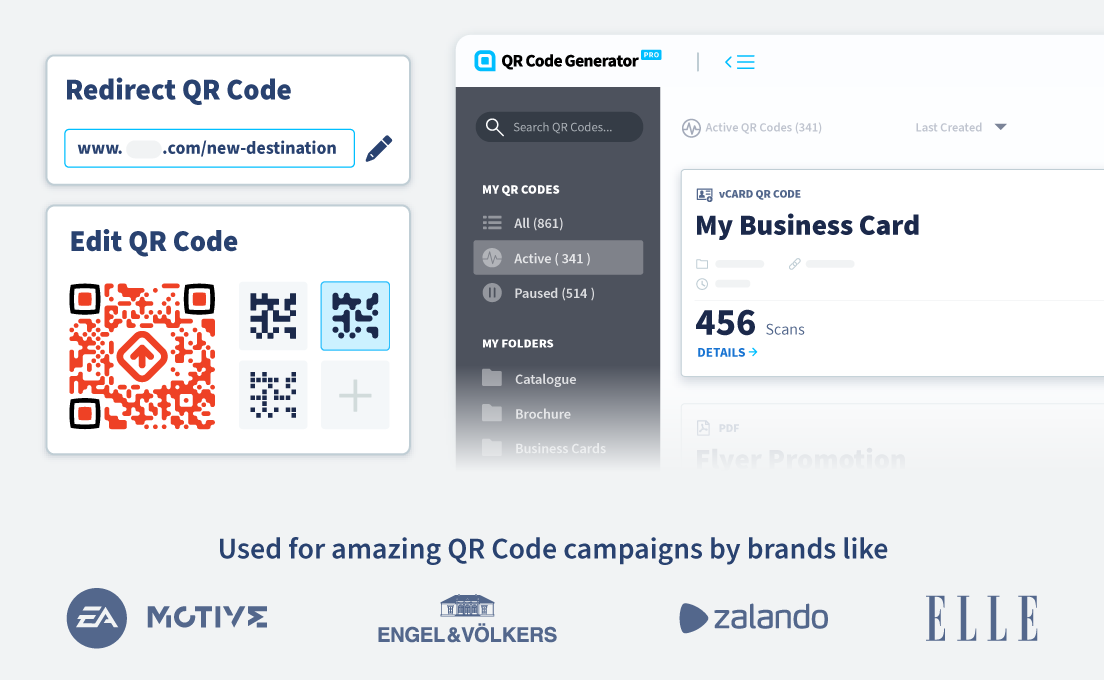
QR Code Generator PRO makes it easy and intuitive to create QR Codes for clothing and branding campaigns. Creating at scale, customizing your designs, and measuring the impact—we’re here to help at every step.
Join QR Code Generator PRO and discover the power of QR Codes for clothing!


 Add custom colors, logos and frames.
